What UAE Businesses Should Understand About Government Administration After Company Formation
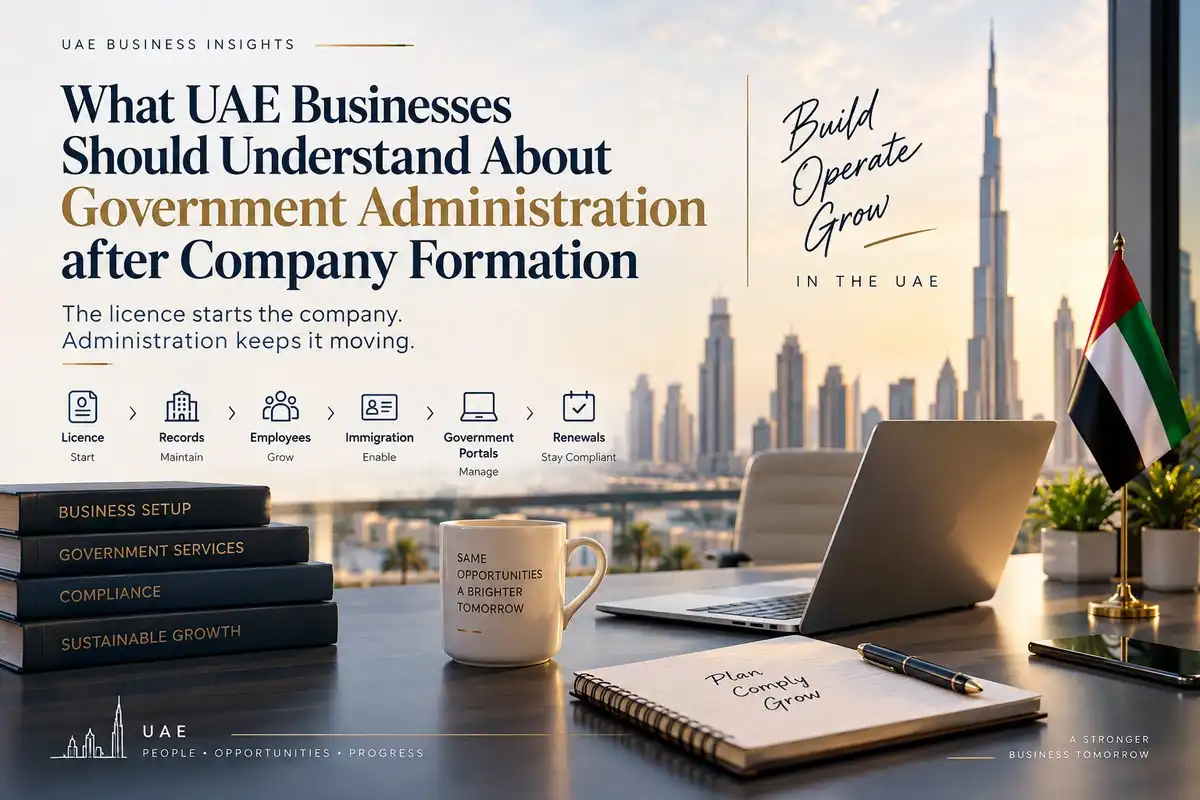
There is a moment many UAE business owners remember clearly: receiving the trade license. After all the planning, documents and approvals, it feels like the company is finally finished. From a government-relations perspective, I see that moment a little differently.
The company has been formed. Now it has to be maintained.
Once a business starts hiring people, processing residence matters, renewing documents, changing company information or using government portals, the owner discovers that the trade license is only one part of a much larger administrative picture.
And in day-to-day government relations work, it is often not the complicated matters that cause difficulty. It is the small thing that was missed earlier and only becomes visible when the next transaction begins.
One Company, Several Government Records
A founder naturally thinks of the business as one company. Government administration does not always work that way.
Depending on the company’s jurisdiction and activities, there may be licensing records, establishment records, immigration records, employment administration and other approvals.
ICP, for example, maintains establishment-card services that record company information and allow amendments such as changes to the trade name, ownership or partners. In Dubai, GDRFA Dubai provides establishment-card services for relevant private-sector and free-zone establishments. [1] [2]
That creates an important practical reality: changing something in one place does not necessarily finish the job everywhere else.
Take a simple example. A company changes its trade name and receives its updated license.
From the owner’s perspective, the change is complete. Before the next government transaction, however, I would still want to know whether the old information remains in another relevant establishment or authority record.
The same thinking applies when partners, managers, authorized signatories or other important company details change.
This has taught me to ask a very simple question whenever company information changes:
“Where else is this information recorded?”
“We Need to Do the Visa” Is Rarely the Whole Story
A business owner may say: “We hired someone. We need to process the visa.” From the business side, that sounds like one transaction. From the administration side, I immediately think about the chain behind it.
Is the company side ready? Are the relevant company records valid? Are the employee’s documents current? Which authority controls the process? What has to happen first? And what comes after that approval?
For establishments registered with MOHRE, work permits are issued through MOHRE procedures.
Residence and identity processes then involve the competent immigration authority; the UAE Government portal identifies ICP services federally and GDRFA Dubai for relevant Dubai residence services. [3] [4]
The exact route is not universal. Free-zone employers generally follow the employment and visa procedures of the relevant free-zone authority, while certain financial free zones such as DIFC and ADGM operate under distinct employment regulatory frameworks. [5]
This is where small issues become visible. An employee may have every personal document ready, but a company-level record needed for the next stage may have expired. The employee file may be perfect and the process can still be delayed.
That is why experienced administration is not only about knowing how to submit an application.
It is about checking the transaction before the transaction.
The UAE Does Not Have One Administrative Route for Every Company
Another lesson I have learned is to be careful when somebody says, “This is the UAE procedure.”
Sometimes the next question should be: For which company?
A mainland company and a free-zone company may not follow the same administrative route.
Different free zones can also have their own systems and procedures. Even where the underlying objective is similar — hiring an employee, renewing a record or completing a residence process — the responsible authority and sequence can differ. [5]
This is why copying another company’s checklist can create problems. Two businesses may both be operating in Dubai and still have different administrative routes.
Before looking at the document list, I prefer to establish the basics: where is the company licensed, which authority controls the transaction, and what is the company’s current status in that system? Once those answers are clear, the rest becomes much easier.
Small Details Have a Habit of Returning Later
Government administration has made me pay attention to details that can look unimportant at first: a new passport, an expired document, a changed manager, an old authorized signatory, a company record updated internally but not externally, or a portal account controlled by somebody who has left the business.
None of these sounds dramatic. But they tend to become important at the exact moment the company needs another transaction completed.
Consider an employee who renews a passport. HR saves the new copy and the internal file is correct. Months later, another government process is required. The useful question is not simply:
“Do we have the new passport?”
It is:
“Was there any external record that also needed to be updated?”
That way of thinking is much more valuable than simply collecting documents.
I Would Never Manage Expiries From Memory
Another practical lesson is that expiry dates should be treated as future work, not future reminders.
Trade licenses, establishment records, passports, residence documents, Emirates IDs and other approvals may all have their own validity periods. If something expires on 30 November, I do not think the important date is 30 November. The important date is when preparation needs to begin.
There is another reason for this: documents are connected. One record may need to be valid before another transaction can proceed. ICP, for example, states that establishment-card renewal requires a valid trade license. [6]
So an expiry tracker should not simply say:
License — expires 30 November.
It should help the business understand:
What could this expiry affect? Who owns the renewal? When should preparation begin?
A basic spreadsheet managed properly can sometimes be more valuable than a sophisticated system nobody maintains.
Government Portal Access Is Also Company Administration
The UAE has moved a significant amount of government administration online. For businesses, that is convenient. But it creates a new operational question:
Who actually controls the company’s government access?
UAE PASS is the UAE’s national digital identity and is used to sign in to many government, semi-government and private services and to sign documents digitally. [7]
This becomes especially important when UAE PASS, authorized signatories, registered contact details and different government portals are involved. If the only person who understands a portal leaves the company, the business should not suddenly have to discover how its own government account works.
I believe government access should be treated like any other important business control: who can initiate something, who can approve it, which contact details are registered, who is authorized, and what changes when somebody leaves?
These are administrative questions, but they are also business-continuity questions.
The Biggest Problem Is Usually Fragmentation
If I had to identify one recurring operational weakness, it would not be a particular visa process or government form.
It would be fragmentation.
The license is monitored by one person. Employee documents are with HR. Immigration is handled elsewhere. Tax is with the accountant. Portal access belongs to somebody else.
Everyone may be doing their individual job correctly, but nobody can see the complete administrative picture.
For me, a well-organized business should be able to answer three questions quickly:
What government records and approvals do we currently maintain?
What needs action next?
Who is responsible for it?
If answering those questions requires searching through emails, old WhatsApp messages and different employees’ folders, there is already room for improvement.
The solution does not need to be complicated.
Keep a proper company document structure. Track expiries. Record responsibilities. Control government portal access. When something changes, check what else it affects.
Most importantly, do not wait for the next application to discover that the previous administrative step was never completed.
The License Starts the Company. Administration Keeps It Moving.
After working with government, immigration and corporate administration in the UAE, I have come to see the job less as processing individual applications and more as maintaining connections.
The license connects to company records. Company records connect to employment and immigration processes. Employee transactions depend on valid documents. Company changes can affect records elsewhere. Digital transactions depend on the correct access and authority.
And today’s small administrative oversight can become tomorrow’s urgent problem.
The UAE has made many government services increasingly digital and accessible. But good systems still depend on good administration.
For business owners, the lesson is simple:
Do not think about government administration only when you need something from the government. Keep the company administratively ready before you need the next transaction.
That is the difference between constantly reacting to government administration and actually managing it.
Official Sources Used for UAE-Specific Factual Points
[3] UAE Government / MOHRE — Work Permits
[4] UAE Government — Residence Visa for Working in the UAE
[5] UAE Government — Recruiting in Free Zones